MIOM
An ambient gut-health companion for life on the move: a wearable sensor, an AI agent, and a communal dock that make an invisible biological transition visible, explainable, and collectively navigated.
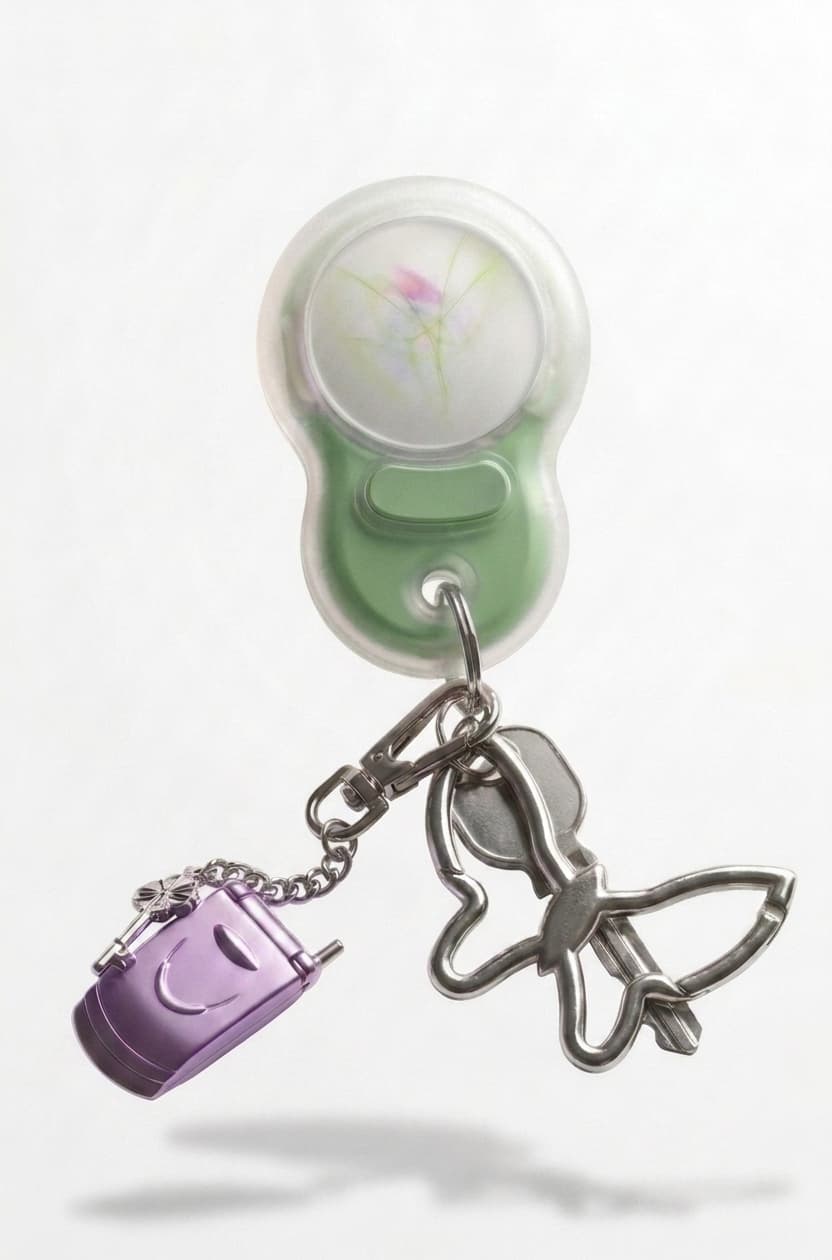
Core Concept
MIOM is the only relocation companion that turns personal environmental data into shared, transparent community understanding through local data storage, connecting the symptoms people notice after moving abroad to the biology that explains them.
My Role
- Interaction and UX designsystem journeys, app flows, and multimodal touchpoints
- AI agent designpersonality, knowledge registers, and dialogue design
- Working app prototypeAPI-first build, then UI synced from Figma via Figma MCP
- Researchuser and expert interviews, synthesis
Problem
Your gut microbiome relocates with you
Every year, millions of people move abroad for study or work. Almost no one tells them that their gut microbiome moves with them, and that it will spend months adjusting to a new food system, water profile, climate, and the compound stress of starting over.
The disruption shows up in the body: stomach issues in the first weeks, low energy that does not resolve, recurring colds, skin reactions, poor sleep. Because each symptom appears separately, each gets blamed on a separate cause. The flight. The stress. The new dairy. The connection between them, a gut adjusting to a radically different environment, is rarely made. This is a health literacy gap, not a medical condition, and no product currently helps people understand it.
Problem Statement
How might we help people who relocate make sense of what their body is going through, not by diagnosing or prescribing, but by connecting, contextualising, and translating?
Research
Established science, unexplained experience
A landmark study by Vangay et al. (Cell, 2018) tracked refugees relocating from Southeast Asia to the United States and found they began losing native gut microbes almost immediately after arrival, with microbial diversity declining for at least ten years. We mapped seven environmental factors that converge during relocation, from food systems and water quality to psychological stress and circadian disruption, each independently documented as a driver of gut disruption.
We interviewed international students and expats who had relocated from seven countries, alongside experts in gut health, internal medicine, public health, and geomorphology. The pattern was consistent: symptoms were noticed in isolation and attributed to single, surface-level causes. Nobody had a framework connecting them.
Key insights
- Symptoms are disconnected, not invisible. The design opportunity is translation, not detection.
- Food is the entry point, not the whole system. People already notice, photograph, and talk about food.
- The act of noticing has value on its own. Photographing a meal produces reflection before any analysis happens.
- Individual experience needs a collective mirror. Discovering that others feel the same thing is the strongest reassurance available.
- The system must be legible, not just intelligent. Transparency about where knowledge comes from is the condition for trust.
The System
Three objects, one loop of mutual learning
The portable device
A small companion carried on a bag or keychain. It passively senses temperature and humidity through the day and actively captures food images through a built-in camera. Its rounded two-lobe form references two microbial worlds meeting: the body's existing ecology and the new environment it is adapting to.
The digital companion
A mobile app housing the AI agent, also named Miom. Conversations happen here, and the adaptation journey is visualised over time as a living data portrait. The agent draws on three knowledge sources: the user's personal data, community knowledge pooled from others in the same transition, and the scientific evidence base.
The communal dock
A shared station in university common spaces. Docking moves data in both directions: personal traces join the community pool, and the accumulated knowledge of everyone who has docked flows back to the device. The dock displays a living visualisation of the collective experience and speaks ambient insights aloud, addressed to no one and available to everyone.
Individual observation → personal sense-making → community contribution → richer collective knowledge → better sense-making for everyone.
Agent Design
A companion, not an assistant
An assistant answers questions and executes tasks. A companion notices things, asks questions back, and is genuinely curious. Miom is designed to feel like the knowledgeable friend you would call after a confusing week in a new country: warm, specific, honest about uncertainty, and never authoritative. It contextualises and invites; the agency stays with the user.
Three knowledge registers
How the agent speaks reflects where its knowledge comes from. Personal data is voiced assertively and specifically. Community knowledge is assertive and collective. Scientific research is speculative and careful. Confidence calibration is a personality decision, not just a technical one.
Miom:I've been looking at what you've been eating this week. A lot of bread, pasta, some dairy, quite a change from what you described at home. You mentioned on Thursday that you felt heavy after lunch. Does that happen often?
User: Pretty much every day.
Miom:That makes sense. Your gut has been used to a very different daily input. What you're eating here is nutritionally fine, but the bacterial landscape is quite different. It takes a few weeks for things to start settling. You're not doing anything wrong.
What Miom never does
- Diagnose symptoms or suggest what a user might have.
- Recommend medications, supplements, or clinical treatments.
- Substitute for medical care or professional advice.
Trust & Ethics
Transparency as an interaction pattern
- Confidence calibration by knowledge source. The agent signals through language where each insight comes from.
- Active consent for community sharing. Nothing joins the community pool without an explicit, physical decision to dock.
- Local data storage. Personal data lives on the phone and device; community data lives in the institution's dock. Nothing goes to a cloud server.
- Assistance without overreach. The system explains patterns and shares experiences instead of prescribing, and directs medical concerns to professionals.
Prototyping
From clay to a working multimodal system
Form finding
The form was explored through fast, soft materials before committing to precise geometry. Clay sketches found the rounded two-lobe language of the portable device; the dock became a low, circular object that invites interaction from all sides in a shared space.
Electronics
Two Arduino Uno Q boards, each paired with a round 240 by 240 LCD display, connected over a Tailscale VPN, so the device and dock could demonstrate the full docking exchange with real state behaviours: sensing, capture, sync, and community transfer.
The app, built API-first
The app prototype started as a basic structure with the AI integration working before any visual polish, so logic and behaviour could be tested early. Once functional, the UI was refined in Figma and pulled directly into the codebase through the Figma MCP integration, keeping the live prototype in sync with the design instead of translating screens by hand.
Reflection
What I'd take forward
Designing an agent across three objects made one thing clear: multimodality is not about adding channels, it is about deciding what each channel should never do. The device notices, the app explains, the dock connects. Keeping those roles strict is what kept the system legible.