Remnants of Absence: Missing Origin
A wearable sensing instrument and four-screen installation that renders residual traces of past occupancy as distortions in Gaussian Splat reconstructions of the scanned space.
🏆 Selected for Fotomuseum Winterthur from 9 projects
Core Concept
A wearable sensing instrument and four-screen spatial installation that detects compound environmental traces of past human occupancy — residual heat, humidity shifts, particulate matter — and renders them as distortions in Gaussian Splat reconstructions of the scanned space.
My Role
- Concept & interaction designresearch framework, sensing logic, and experience narrative
- Physical instrumentwearable sensor design, hardware assembly, and electronics integration
- VisualisationGaussian Splat processing and custom GLSL displacement shader
- Installationspatial configuration across four screens
Concept
Making the invisible occupancy of space perceptible
Every space holds traces of the people who were once in it: residual heat, microscopic particles, shifts in humidity. Remnants of Absence is a wearable instrument and spatial installation that makes these environmental traces legible as presence.
The project explores the gap between detection and attribution: a space can register that someone was here, but it cannot know who. The installation holds that gap open, making occupancy perceptible while keeping identity irresolvable.
Core tension
The project holds open the gap between detection and attribution: a space can register that someone was here, but cannot know who. Occupancy becomes perceptible; identity remains irresolvable.
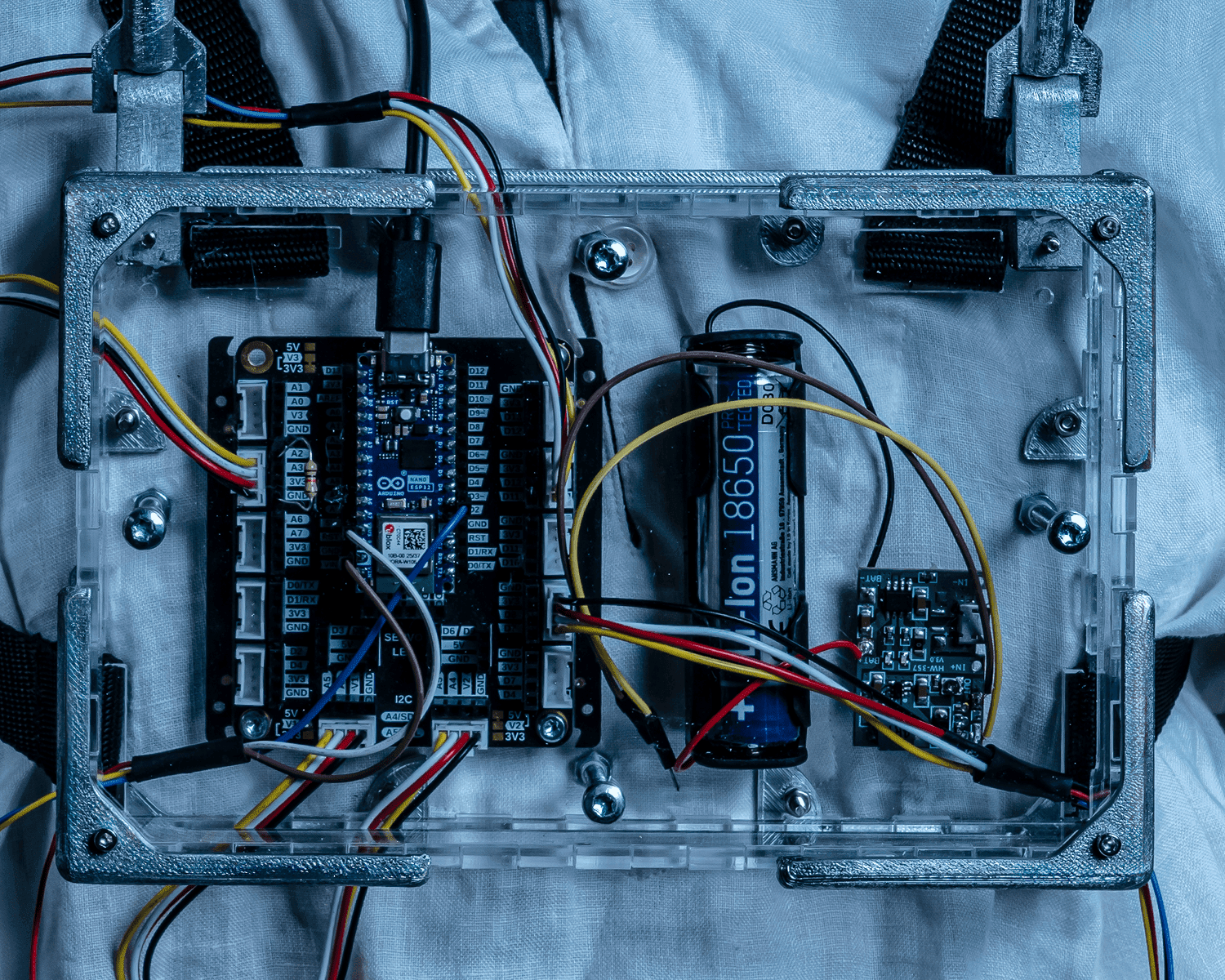
The Instrument
A two-part wearable scanning system
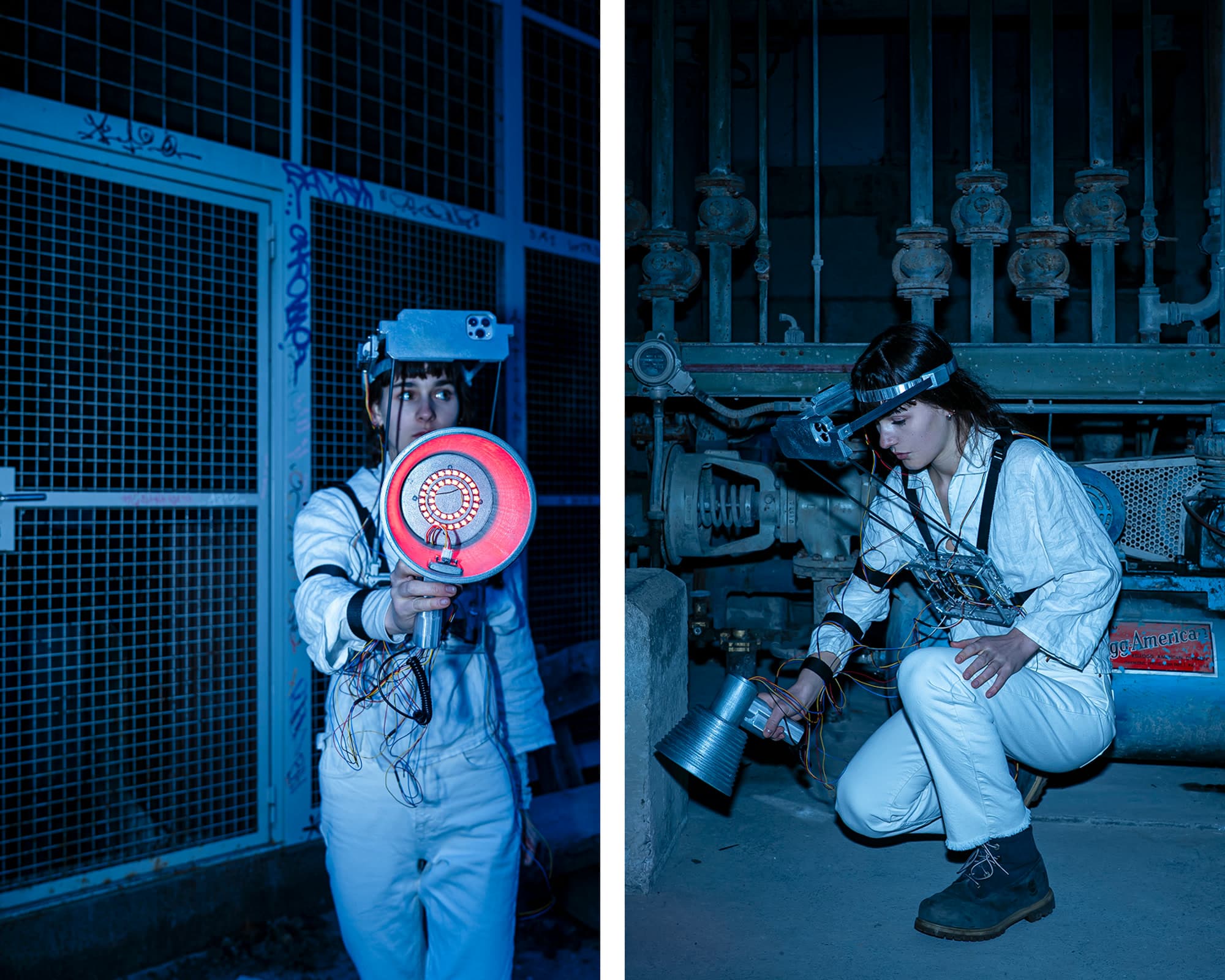
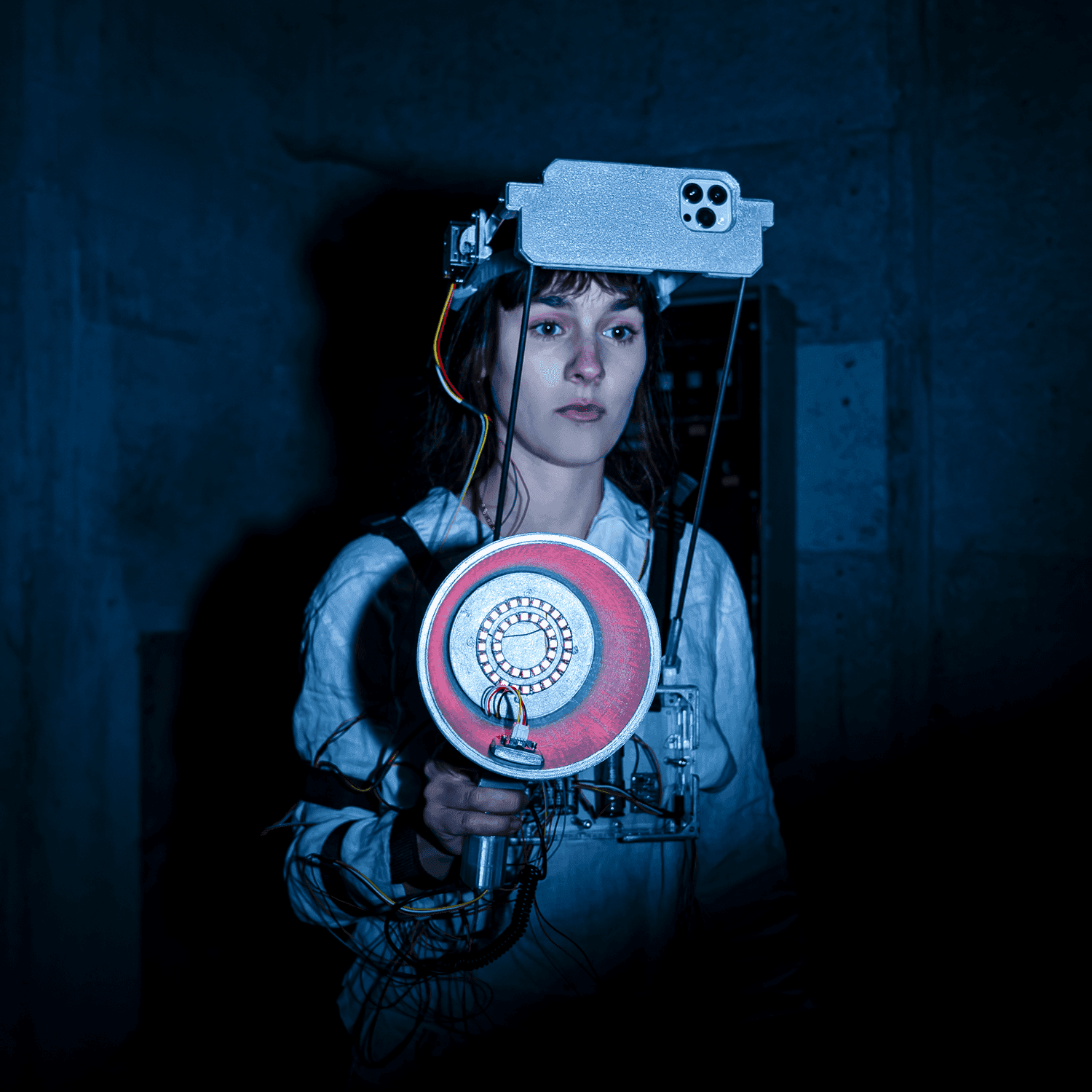
The instrument is worn by a performer moving through space. It has two components that work in tandem: a Scanner that captures spatial geometry, and a Sensor that reads environmental data.
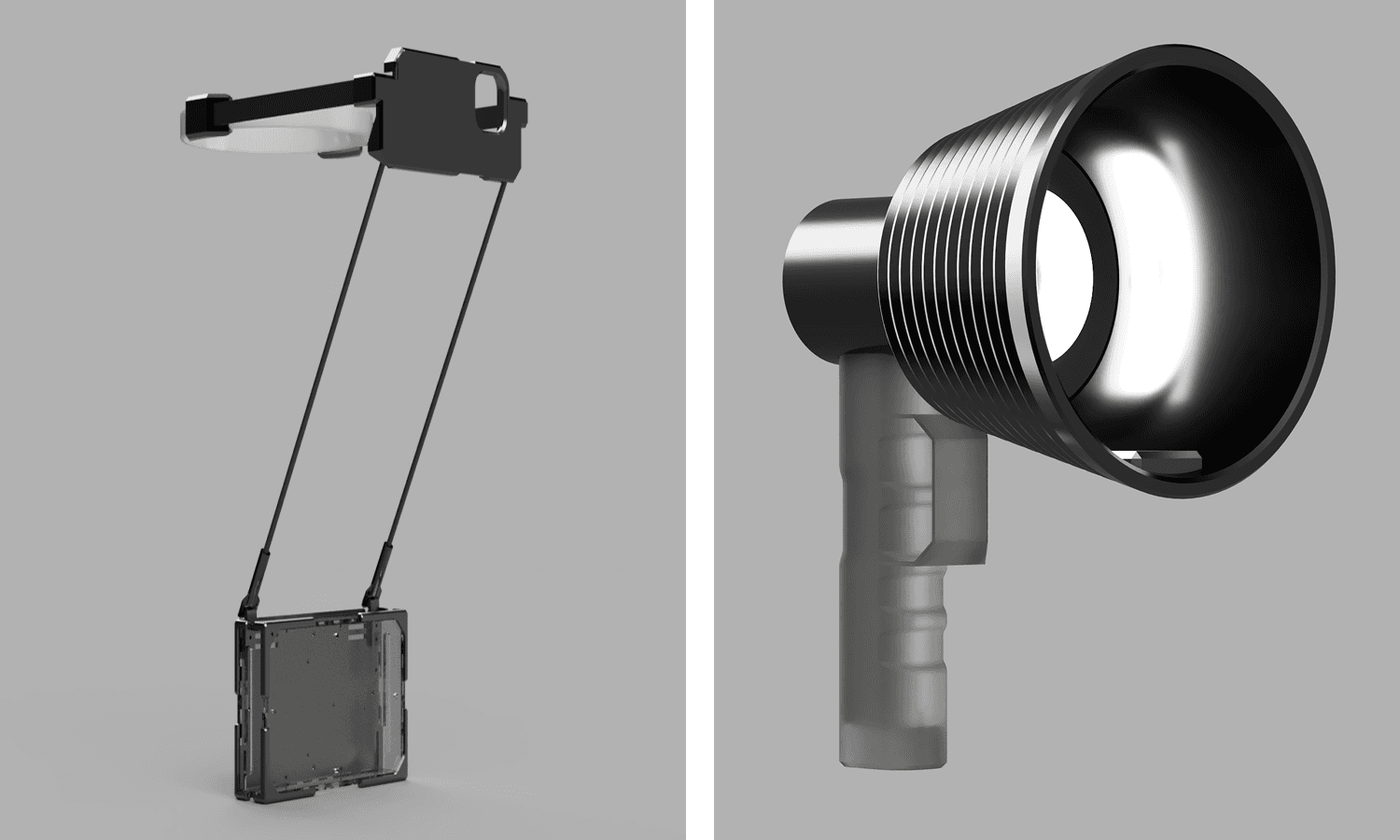
The Scanner
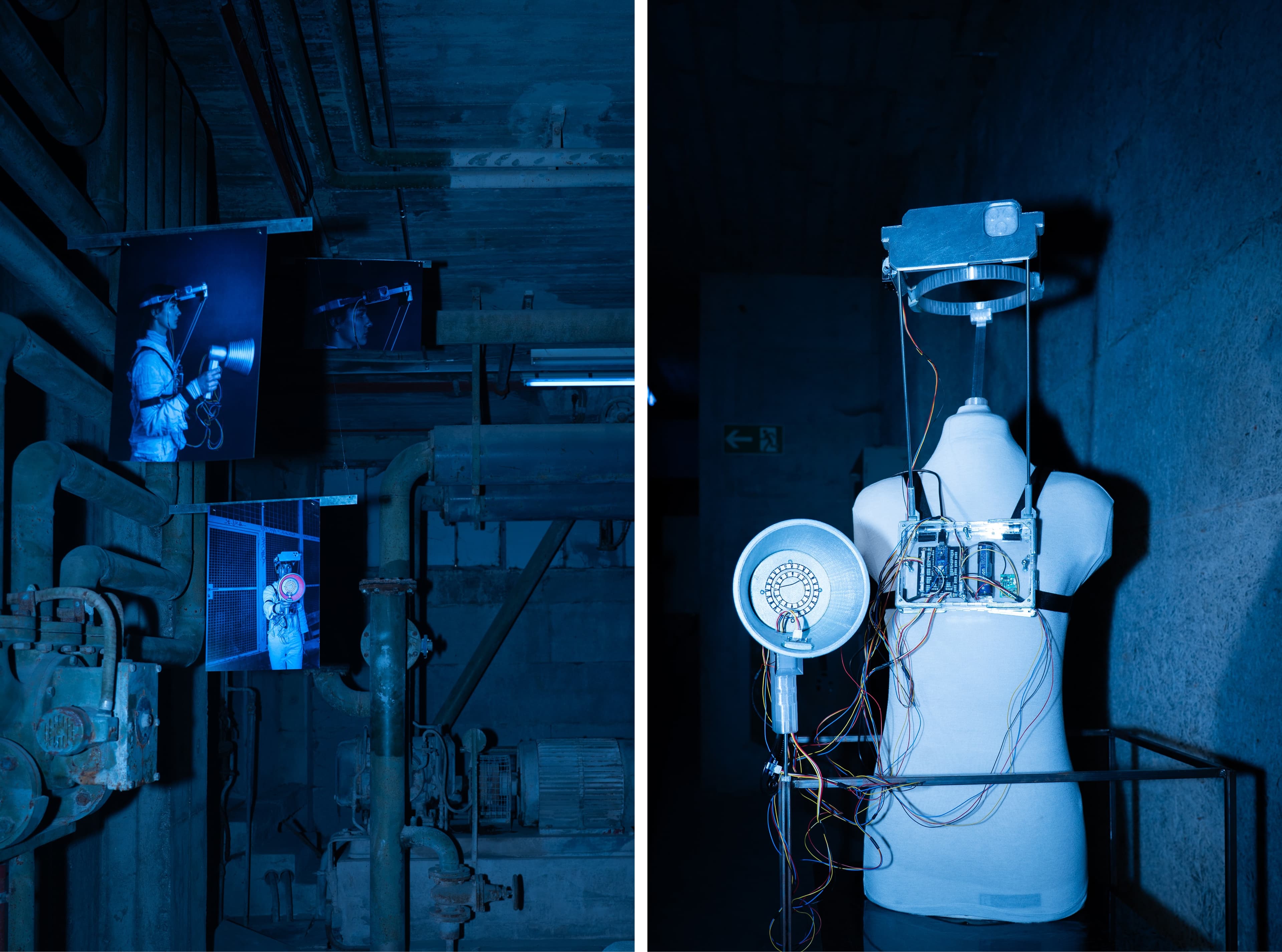
A headband-mounted unit carrying an iPhone running Luma AI for photogrammetric scanning. As the performer moves through a space, the Scanner continuously captures spatial data that is later processed into a 3D Gaussian Splat, a volumetric reconstruction of the scanned environment.
The Sensor
A handheld conical form housing three environmental sensors: galvanic skin response (GSR), temperature and humidity, and PM2.5 particulate matter. A NeoPixel ring on the Sensor responds in real time, glowing red when all three channels simultaneously deviate from baseline, signalling the presence of environmental traces.
Sensing logic
The NeoPixel triggers only when all three channels deviate simultaneously, reducing false positives and ensuring that only compound environmental anomalies register as "presence." A single channel deviation (e.g. a draught changing humidity) is ignored. Convergent deviation across all three channels is read as a trace.
Visualisation
Gaussian Splat + GLSL displacement
The spatial scans are processed into Gaussian Splats, a rendering technique that represents scenes as clouds of positioned, coloured Gaussians rather than polygonal meshes. This gives the reconstructed spaces a characteristic softness that sits between photograph and memory.
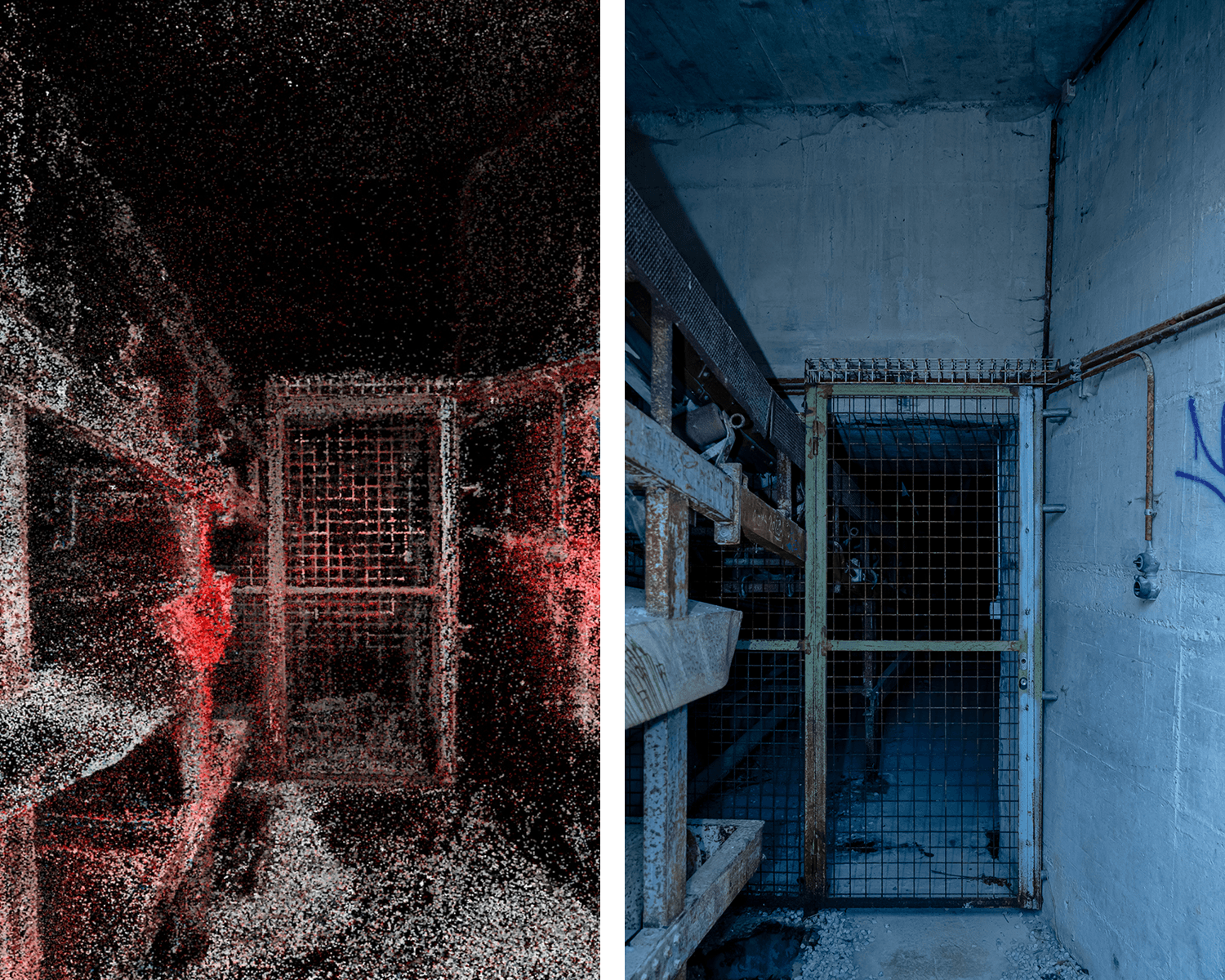
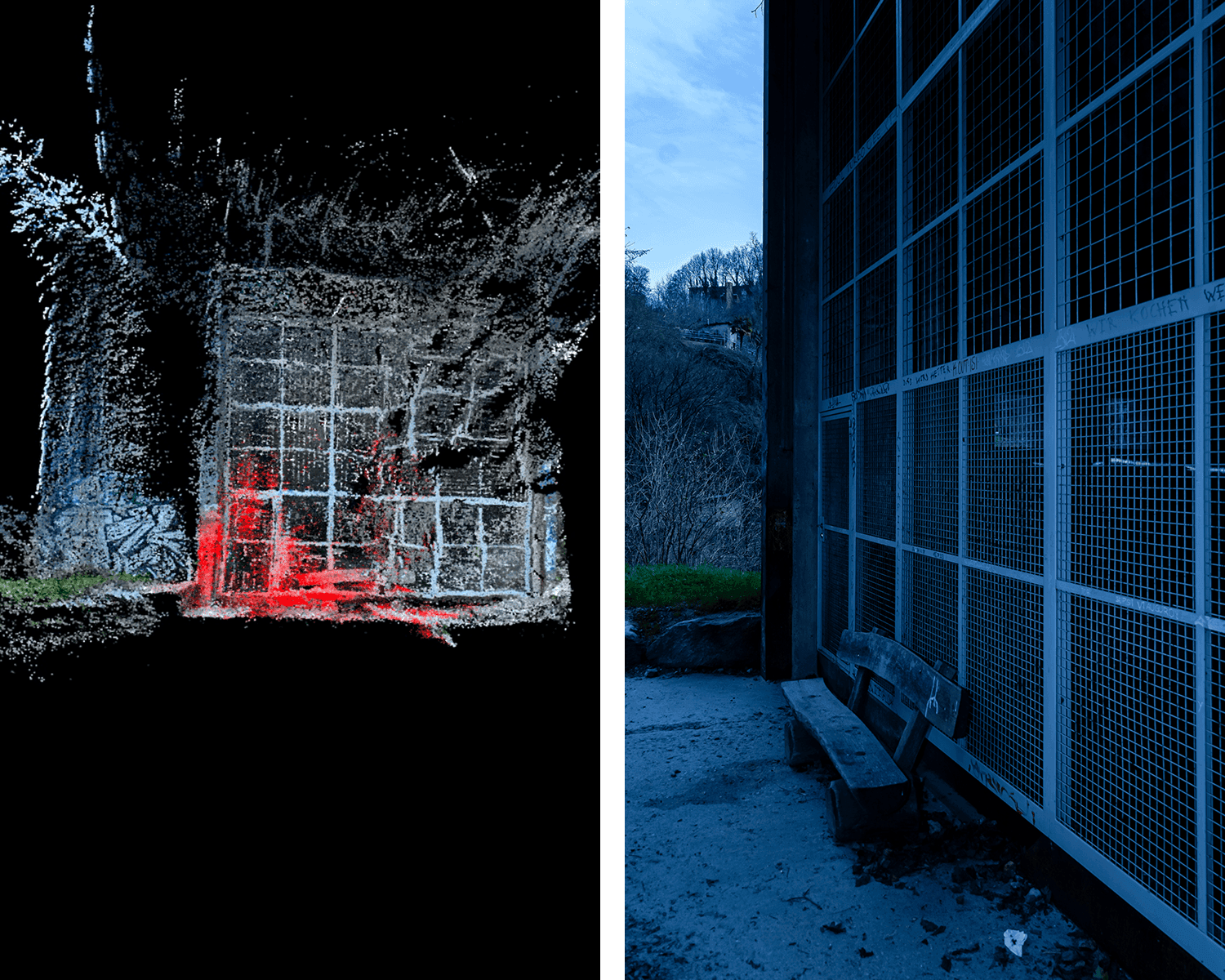
The Splats are then run through TouchDesigner with custom GLSL shaders that apply displacement based on the sensor data. Zones of detected environmental deviation appear as distortions in the spatial reconstruction, making invisible occupancy legible as visual disruption.
Installation
One large screen, three smaller ones
The installation presents the processed scans across four screens: one large central display showing the full spatial reconstruction, and three smaller screens showing detail views showing specific zones of the space where environmental traces were detected.
Result
Selected from 9 projects for Fotomuseum Winterthur; exhibited as a four-screen spatial installation where visitors experience processed Gaussian Splats distorted by real environmental sensor data captured during the scanning performance.
The space cannot know who was here. It can only register that someone was.